
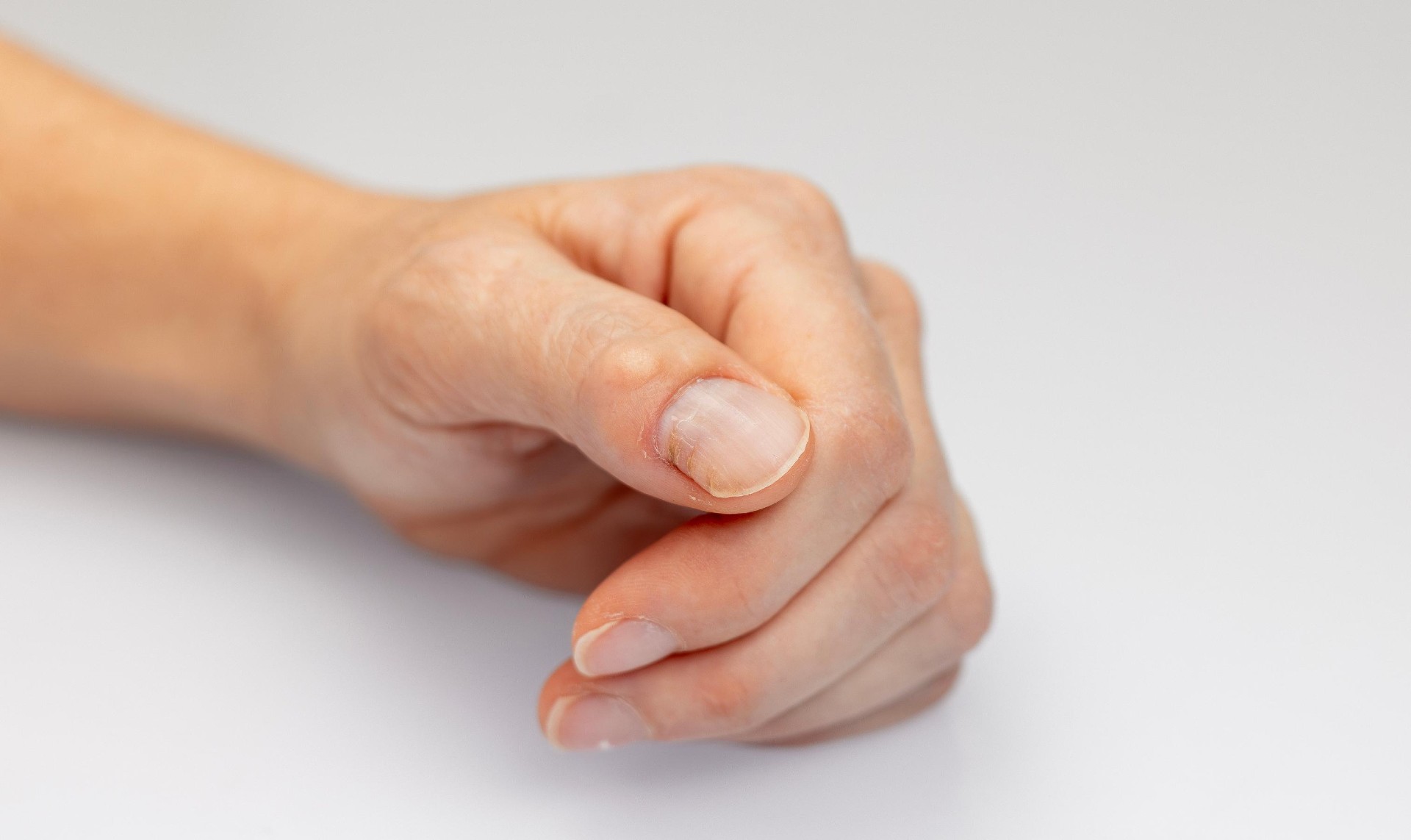
You reach for your coffee mug one morning and notice something new: a small, round bump sitting just behind the nail on your index or middle finger. It wasn’t there a few weeks ago, and now it seems a little larger. Maybe it aches slightly when you grip something, or you’ve spotted a groove forming in the nail itself.
A lump near the fingernail can come from several benign or inflammatory causes, originating in the skin, the nail bed, the DIP joint, or the nearby tendon sheath. The most common culprits are digital mucous cysts and paronychia, though arthritis-related bony changes and less common growths also belong on the list. Many of these bumps are harmless, but they can still lead to pain, nail deformity, or infection if left unchecked.
An orthopedic surgeon who specializes in hand and upper-extremity care is well positioned to determine what’s causing the lump and whether it needs treatment. Below, we cover the most common causes, warning signs, how diagnosis works, and the full range of treatment options for fingernail cyst — including when surgery such as mucous cyst excision may be recommended.
Key Takeaways
- The most common causes of a lump near the fingernail include digital mucous cysts, arthritis-related bony bumps (Heberden’s nodes), ganglion cysts, and nail fold infections such as paronychia.
- Digital mucous cysts are a type of ganglion cyst that commonly arise from the distal interphalangeal (DIP) joint and can deform the nail bed, cause pain, and increase infection risk if they rupture.
- Any painful lump, growing, draining fluid, or repeatedly returning should be evaluated by an orthopedic hand specialist to rule out serious conditions.
- Treatment ranges from observation, aspiration and non-surgical care to surgical treatment, such as mucous cyst excision, depending on the diagnosis and symptom severity.
- When the cyst stalk and any contributing bone spurs are fully removed during surgery, recurrence rates can be as low as 2%.
Concerned About a Lump Near Your Fingernail?
If you have noticed a new lump, pain, swelling, or nail changes around your finger, an evaluation can help determine the cause and whether treatment is needed. At Academy Orthopedics, our fellowship-trained orthopedic physicians provide specialized hand and upper-extremity care with a personalized, patient-first approach. Call 770-271-9857 to schedule an appointment and get the care you need.
What Can Cause a Lump Near the Fingernail?
Several different conditions can create a lump near the nail, and they often look deceptively similar on the surface.
- Digital mucous (myxoid) cysts — A form of ganglion cyst usually found on the top of the finger, connected to the DIP joint by a narrow stalk.
- Other ganglion cysts — These can appear near other finger joints or tendons, including volar retinacular cysts arising from the flexor tendon sheath.
- Osteoarthritis-related bony enlargements — Heberden’s nodes at the distal phalanx are hard, bony lumps caused by degenerative changes in the joint.
- Nail fold infections — Paronychia is a red, swollen area caused by bacterial or fungal infection, often from skin injury or irritation around the nail, and commonly affects the nail fold closest to the hand.
- Traumatic causes — Crush injuries, blood collecting under the nail, or scar tissue nodules. Infections and trauma are common precursors for lumps appearing near fingernails.
- Less common growths — Pyogenic granulomas are smooth, reddish lumps that bleed easily after minor trauma. Warts can develop from HPV infection and appear around the nail fold. Glomus tumors and other rare nail bed tumors require prompt evaluation.
The exact cause of many ganglion and mucous cysts isn’t always clear, but degeneration of the joint capsule and tendon sheath often plays a role. Location, speed of growth, and associated symptoms — pain, warmth, nail changes — help narrow the possibilities, but self-diagnosis isn’t reliable.
Also Read: A Comprehensive Guide to Treating a Ganglion Cyst on Your Hand: Symptoms, Diagnosis, and Solutions
Could a Digital Mucous Cyst Be Causing the Bump?
Digital mucous cysts (also called digital myxoid cysts) are one of the most common reasons adults notice a lump near the base of the fingernail. A mucous cyst is a small, fluid-filled sac connected to the DIP joint by a narrow stalk, typically containing thick, clear, jelly-like fluid. They’re often linked to joint irritation or arthritis in the same joint.
These cysts usually appear on the back of the finger near the nail fold or over the DIP joint itself, and occasionally just in front of the nail, which can alter nail growth. Typical symptoms include:
- A smooth, dome-shaped bump near the base of the nail on the index or middle finger
- Nail deformity — a groove, split, or ridge from pressure on the nail bed
- Mild aching or tenderness, especially when bumped or with gripping
As the skin over the cyst thins, the risk of rupture rises, along with drainage of clear fluid and a real risk of joint infection if bacteria get in. Recurring or painful cysts should be evaluated for possible surgical removal.
Could Arthritis Be Behind the Lump on Your Finger?
Osteoarthritis is a leading driver of bumps near the fingertip joints, especially in patients over 45–50. Radiographic hand osteoarthritis affects roughly 40% of adults over age 40, and that prevalence climbs steadily with age.
Heberden’s nodes are bony enlargements at the DIP joints caused by osteoarthritis. They’re hard to the touch, not fluid-filled like digital mucous cysts, and commonly show up on the index, middle, and ring fingers of both hands. Associated symptoms include joint stiffness and reduced motion (particularly in the morning), aching when gripping keys or opening jars, and a joint deformity that enlarges gradually over years rather than weeks.
Arthritis-related changes can create bony lumps on their own and also contribute to digital mucous cysts forming through degeneration of the joint capsule and surrounding tissue. Mucous cysts and DIP joint osteoarthritis are very commonly found together in surgical patients. When a lump near the nail is linked to osteoarthritis, treating the underlying joint problem alongside the cyst is important to prevent recurrence and long-term pain.
How Can You Tell a Cyst From a Bony Lump or Other Growth?
Only a trained clinician can reliably tell the difference between a cyst, a bony node, an infection, or a tumor, but there are a few practical clues patients may notice.
- Consistency — Cysts (including mucous and ganglion cysts) may feel rubbery or fluid-filled, while bony lumps are hard and immobile.
- Movement — Some ganglion cysts shift slightly with finger motion; bony enlargements move as one unit with the bone.
- Skin and nail changes — Mucous cysts can cause nail ridges or grooves, infections show redness and warmth (sometimes pus), and tumors may cause color changes or bleeding.
- Growth pattern — Cysts may gradually enlarge or shrink, bony nodes change slowly over months to years, and rapid growth, ulceration, or unexplained bleeding are red flags for more serious conditions.
Nail bed or under-the-nail lesions are especially hard to evaluate at home and should always be checked if painful, dark, or changing shape. Never try to squeeze or puncture a lump yourself — doing so can turn a benign cyst into a serious joint or bone infection.
When Should You See a Hand Specialist About a Lump Near Your Nail?
Don’t ignore persistent or worsening changes near your fingertips. See an orthopedic hand specialist if you notice:
- The lump slowly or rapidly increasing in size
- Persistent pain, throbbing, or tenderness that interferes with daily activities
- Signs of infection — increasing redness, pus drainage, warmth, or streaking up the finger
- Visible nail changes such as grooves, splitting, or lifting of the nail plate
- Limited bending or straightening of the finger joint, or a feeling of instability
- Numbness, tingling, or burning around the fingertip
- A new lump following recent trauma
- A lump that keeps returning after previous drainage or self-treatment
Patients with diabetes, circulation problems, or a weakened immune system should seek care sooner for any sign of infection near the nail. Early evaluation often means simpler treatment and can prevent complications like permanent nail deformity or joint damage.
How Does a Hand Specialist Diagnose a Lump Near the Fingernail?
Most evaluations can be completed in the office, often in a single visit.
- Medical history — When the lump appeared, how it’s changed, your pain level, and any history of arthritis or previous cysts.
- Physical examination — Checking the finger, nail bed, nail folds, and nearby joints for tenderness, warmth, and texture.
- Functional assessment — Evaluating finger motion, grip strength, and signs of osteoarthritis in the DIP joint.
When imaging is appropriate, X-rays assess joint condition and arthritis severity, revealing joint space narrowing, bone spurs, and degenerative changes linked to mucous cysts or Heberden’s nodes. In select cases, ultrasound or MRI may be ordered if the diagnosis is unclear or the mass is deep, unusual, or concerning for a tumor.
For classic digital mucous cysts, history, physical exam, and targeted X-rays are usually enough to confirm the diagnosis and plan treatment, whether that means observation, non-surgical care, or surgery.
What Treatments Are Available for a Lump Near the Fingernail?
Treatment depends on the cause, symptoms, and impact on function — not every lump or cyst on ring finger needs surgery.
Non-surgical options
- Observation for small cysts that are painless and not deforming the nail or threatening to rupture
- Activity modification, splints, or anti-inflammatory medication for underlying osteoarthritis pain
- Warm water soaks and, when needed, antibiotics for paronychia
Minimally invasive measures
- Needle aspiration for small mucous cysts, though recurrence is common if the stalk and joint connection aren’t addressed
- Corticosteroid injections are often avoided at the fingertip, since the thin skin there is prone to thinning further
Surgical treatment is considered when:
- A persistent, painful, or recurrent mucous cyst is deforming the nail or threatening to rupture
- A ganglion cyst limits motion, compresses a nerve, or interferes with daily activities
- A suspicious or unusual mass needs full removal to confirm the diagnosis and provide a cure — glomus tumors, for example, require surgical removal as the only definitive treatment
Careful, experienced surgical technique is essential to minimize complications like joint stiffness or nail bed injury. In severe, recurrent cases involving advanced arthritis, joint fusion (arthrodesis) can reliably prevent the cyst from coming back. Across the published research, surgery has the highest cure rate of any treatment for mucous cysts — about 95%, compared to roughly 39% for simple needle drainage alone.
Surgical options typically include removing the cyst along with its stalk, cleaning up the joint capsule, and removing any contributing bone spurs, usually performed under local anesthesia in an outpatient setting.
What Is the Mucous Cyst Excision Process Like?
Mucous cyst excision is a common, targeted procedure used when a digital mucous cyst is painful, recurrent, or damaging the nail.
Anesthesia and setting — Typically performed under local anesthesia as an outpatient procedure, numbing the finger with a digital block, sometimes with light sedation.
The surgical steps
- A small incision is made over the cyst on the back of the finger, near the nail.
- The surgeon carefully dissects through the skin to expose the cyst, its wall, and the narrow stalk connecting it to the DIP joint.
- The cyst and its stalk are removed, along with any contributing bone spurs, while protecting the nail matrix, tendon, and surrounding nerves.
- If the skin over the cyst is too thin to close, a small skin graft or local tissue flap may be used.
Closure and immediate care — The incision is closed with fine sutures, and a protective dressing or splint is placed. Nearby joints are kept moving during recovery to reduce stiffness.
Recovery expectations — Most patients have some soreness for several days, with a gradual return to light hand use within one to two weeks. Full healing — especially visible nail improvement — can take several months, since nail growth is slow. Overall recovery also depends on the extent of any underlying arthritis and existing nail bed changes.
Recurrence is lowest when the stalk is completely removed along with the cyst — as low as 2% in published series, compared to a much higher chance of the cyst returning after aspiration alone.
Can a Lump Near the Fingernail Go Away on Its Own?
It depends on the cause. Small digital mucous or ganglion cysts may stay stable for years, shrink, or occasionally resolve without treatment. Heberden’s nodes usually stay or gradually enlarge and rarely disappear on their own. Nail fold infections usually improve with proper care, but chronic or recurrent paronychia can persist if the underlying irritation isn’t addressed.
“Watching and waiting” is reasonable only when the lump is small, painless, and not changing; there’s no redness, drainage, or sign of infection; and a hand specialist has already evaluated it and recommended observation. Assuming a lump is harmless without a proper evaluation can delay diagnosis of a more serious problem — including certain nail bed tumors that first show up as subtle changes near the nail. Any lump that grows, becomes painful, or starts draining fluid should be reassessed promptly.
What Should You Do If You Notice a New Lump on Your Finger?
Do:
- Gently monitor the lump, noting its size, color, tenderness, and any nail changes
- Take photos over several days or weeks to document changes for your doctor
- Keep the skin clean, intact, and protected from friction — especially if it looks thin or shiny
Don’t:
- Squeeze, puncture, or try to drain the lump yourself — this can turn a benign cyst into a serious joint or bone infection
- Use over-the-counter wart medicine or harsh chemicals on a suspected cyst
- Ignore redness, warmth, or new drainage — these can signal an infection that may spread to the joint
Seek professional evaluation if the lump persists for more than a few weeks, you’re experiencing pain, stiffness, or nail deformity, or you have a history of mucous cysts, ganglion cysts, or osteoarthritis and notice a new or recurrent bump. An accurate diagnosis is the first step toward effective, individualized treatment and relief.
Also read: What Are the Most Common Hand Problems and Symptoms? Insights from a Cumming, GA Hand Specialist
Get Personalized Care for Hand and Finger Problems in Buford, GA
Academy Orthopedics is a physician-owned orthopedic practice providing specialized hand and upper-extremity care for patients in and around Buford, GA. Our team has extensive experience with conditions like digital mucous cysts, ganglion cysts, arthritis-related finger deformities, nail bed injuries, and other fingertip and nail fold problems.
Our patient-first approach means a thorough evaluation, a clear explanation of your diagnosis, an honest discussion of both non-surgical and surgical options — including mucous cyst excision when needed — and a personalized recovery plan built to restore comfort, motion, and function.
Call 770-271-9857 to schedule a consultation about a new or persistent lump near the fingernail, or any other hand concern.
If a lump on your finger, nail changes, or hand pain is causing you worry, don’t wait. Contact Academy Orthopedics today to take the first step toward answers and relief.
Frequently Asked Questions
Is a mucous cyst near my fingernail dangerous?
Digital mucous cysts are benign, but they can cause nail deformity, skin breakdown, and infection if they rupture. Ignoring an open or draining cyst can allow bacteria into the DIP joint or bone, leading to a more serious infection. Have any new or changing lump evaluated to confirm the diagnosis and review safe treatment options.
Do mucous cysts always mean I have arthritis?
Often, but not always. Many patients show clear joint changes on X-ray, while others have minimal or no visible arthritis despite having a cyst. Your hand specialist may recommend imaging to check for subtle degenerative changes even if you haven’t been diagnosed with arthritis before.
Will my nail return to normal after mucous cyst excision?
Many patients see gradual improvement in nail grooves or ridges once pressure from the cyst is relieved. Because nail growth is slow, visible changes can take several months. Long-standing or severe deformities may not fully reverse, but surgery often prevents further damage and can meaningfully improve appearance.
How long does recovery take after cyst excision on the finger?
Light use of the hand often resumes within one to two weeks, with most patients back to normal activities in three to four weeks depending on job demands. Some soreness and stiffness can persist, especially with underlying arthritis, but motion exercises help restore flexibility. Your surgeon at Academy Orthopedics will give you an individualized recovery plan.
Can digital mucous cysts or ganglion cysts come back after surgery?
Recurrence is possible but significantly reduced when the entire cyst, its stalk, and any contributing bone spurs are removed — recurrence rates after well-performed excision are as low as 2% in published studies, compared to a much higher chance after simple aspiration alone. If a cyst does return, your hand specialist can reassess the joint and discuss further options, which in more advanced cases may include joint fusion.